I’ve been tearing through these Mark Twain stories since my post yesterday, and he has me thinking about how humor works in writing. Humor is one of those things that is so hit or miss I just can’t ever fully wrap my head around it. Even professional comedians make jokes that just don’t strike me as very funny, even though I can tell they were supposed to be. I’ve said this before, but the point of the blog is to learn, and one thing I’d really like to know how to do is make people laugh. I’m going to do this in two parts, because it’ll be an overly long post otherwise.
Since I was very young, my favorite cartoons were always the kind that blend clever jokes with more straightforward humor. I refuse to call them dumb jokes here (even if they come off that way) because a straightforward ‘haha, funny!’ needs to be an excellent joke to actually get a laugh. Anybody can repeat a clever joke they’ve heard and it’ll be funny, but I’m convinced that only a genius can make a ‘dumb joke’ work consistently, original or otherwise. But what is a straightforward joke? What makes a joke more clever? I think I need some examples to make it more obvious.
I want to look at the first cartoon I ever got obsessed with, Tom and Jerry. This is about as straightforward as you can get. Slapstick humor right up there with Larry, Curly, and Moe, only with the added absurdity that animation brings to the party. Without any context at all, Tom and Jerry can elicit a laugh. Look at this still frame for example.
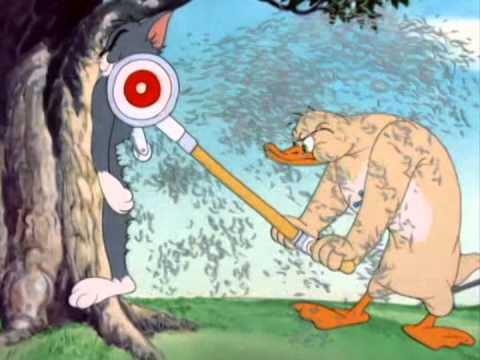
If you’ve ever pissed off a duck you know how Tom feels in this moment. Even if you haven’t, this is just plain funny. I don’t know why exactly. I just see a cartoon cat getting mowed by a very displeased duck and I get a kick out of it. The problem is, this doesn’t really relate to written jokes in an obvious way. It’s a visual gag, and if I described a duck mowing a cat, it just wouldn’t be that funny. This image is hilarious in my opinion, but not really helpful for writing jokes at first glance. Let’s move on to something else that might be more informative.
Look at this one:
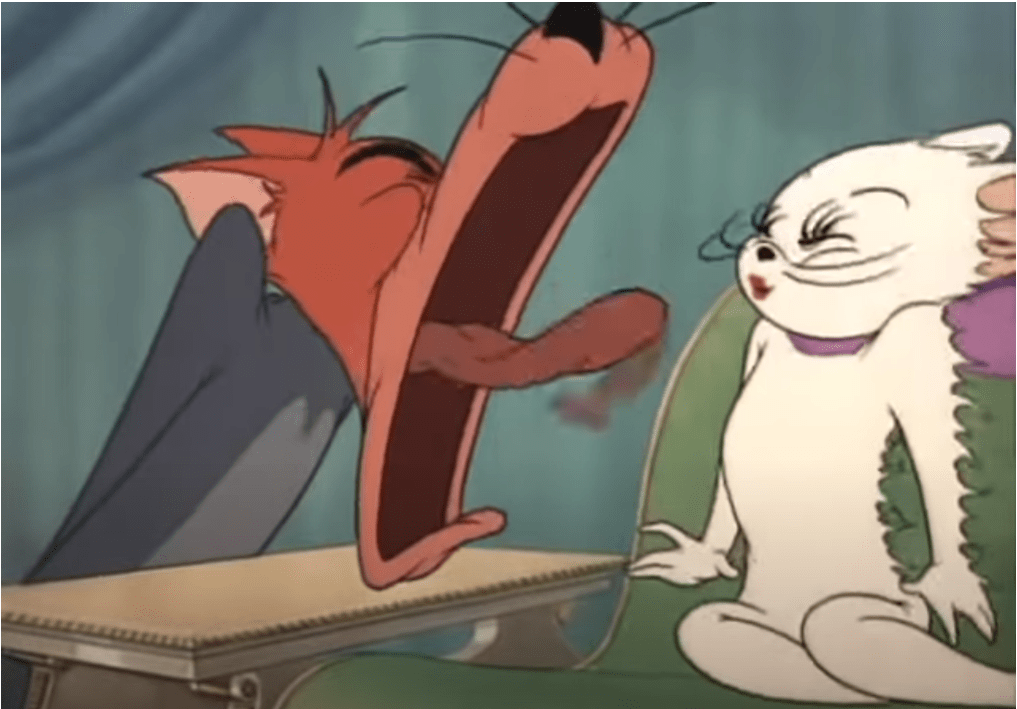
Just as funny to look at, but it’s a little less straightforward. Here, Tom is trying to impress the lady cat (who’s name is Toodles Galore by the way), adding a social layer to the joke. When Jerry crushes Tom’s tail off screen, he makes this face and embarrasses himself. Of course it’s still obvious even to a child why being embarrassed in front of your girlfriend to this extent is hilarious, so I’d still put this firmly into the straightforward category, but if you squint your brain maybe you could see this being written down somehow. What I’m trying to say is that beyond the visual there is a conceptual aspect to the joke that doesn’t need any visual support. It’s the most basic form of the ‘clever’ side of jokes that I mentioned I love to see. It wouldn’t be as funny without Toodles there for Tom to get embarrassed over. I think this hints at a deeper level of humor that is much easier to bring out through words than a purely visual gag.
Another cartoon from my childhood that still gets me laughing every time I see a still frame is Spongebob Squarepants. This is the kind of children’s show that tries to appeal to adults as much as it can because the writers know who really changes the channel. It results in a lot of funny jokes that a kid just won’t get, probably because they’re just too clever. I could give you a thousand, maybe ten thousand funny stills from Spongebob to talk about, but honestly I think all of them pale in comparison to the raw humor present in the concept of Spongebob Squarepants. Here is how Stephen Hillenburg originally pitched Spongebob from the 1997 Spongebob pitch bible. He was known as Sponge Boy back then.
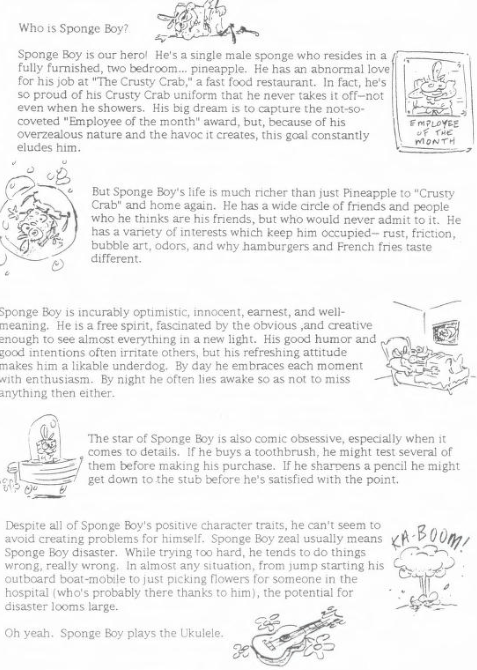
My favorite part of this, and the part that I think makes the show what it is, is this: “Despite all of Sponge Boy’s positive character traits, he can’t seem to avoid creating problems for himself.” … “While trying too hard, he tends to do things wrong, really wrong. In almost any situation […] the potential for disaster looms large.”
To me, looming disaster sounds like great conflict, and conflict makes for juicy story telling. It’s the most conflict inducing character flaws that make Spongebob such a nuisance, and therefore so funny. I’ve talked before about how conflict makes a story compelling, and that without it you might as well not be writing anything at all, but how can conflict generate both humor and a compelling plot? In other words, is conflict at the root of humor, and if yes, then how so? This is what I’d like to cover in tomorrow’s post, but for now, look back over the Tom and Jerry stills, or go search for some of your own. See if you can find a still that you know is funny, but doesn’t have any obvious conflict going on. I don’t think you’ll be able to very easily. Even in a still with only one character, the funny part of it usually results from conflict ‘off screen’ so to speak.
Thank you for reading, and I hope you’ll be happy to read more about this topic tomorrow as well.
Benjamin Hawley
 Dangerous Day Job