One of my favorite sci-fi concepts is the idea of building megastructures in space. From the humble space elevator all the way up to the Dyson sphere, these gigantic structures have only ever existed in our minds, but somehow, they seem so close to reality. So many books, movies, videogames, and other media feature megastructures that they have become a commonplace method of imaginary space habitation. In fact, I don’t think anybody really uses anything but megastructures. It just wouldn’t make that much sense for everybody to live in their own tiny spaceship would it? Today I want to go over some of my favorite fictional megastructures, how they would work, and where you can find them in fiction.
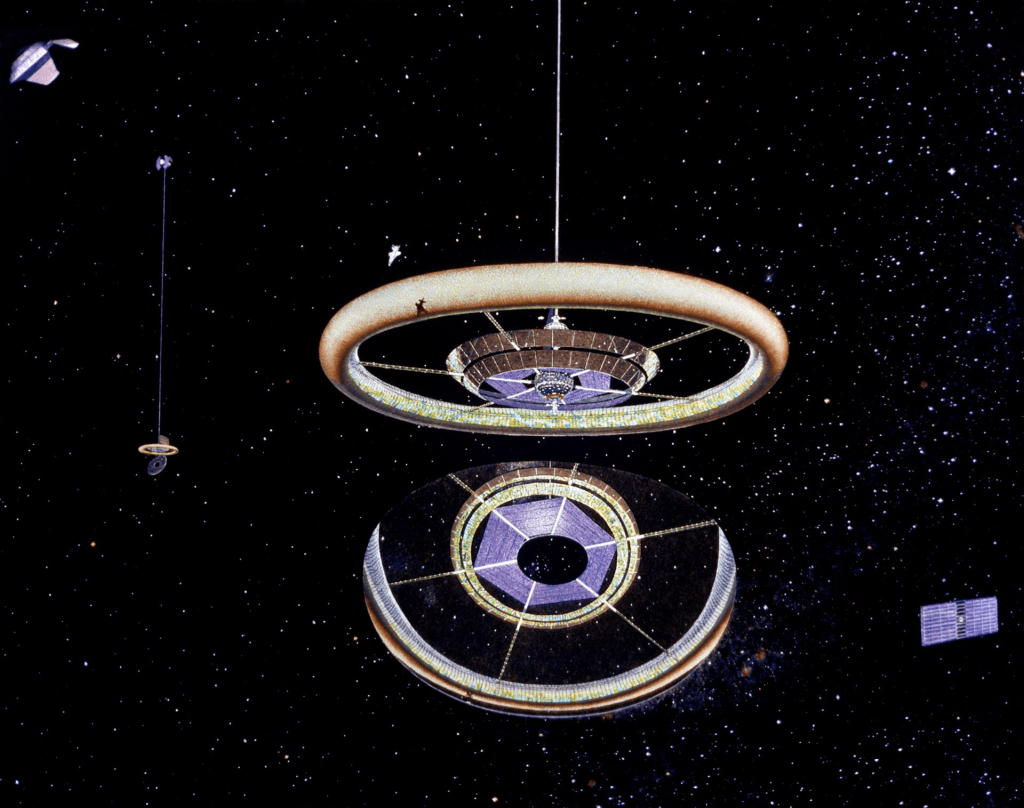
The Stanford torus is probably the most famous example. It’s essentially a giant habitable ring that spins to create a sense of gravity. Proposed back in 1975 during a NASA Summer Study at Stanford University, this thing has captured the imagination of so many people that we don’t even think of it as far fetched anymore. It feels like half the sci-fi books I’ve ever read feature a Stanford torus space station. There’s the training base in ‘Ender’s Game’, basically every space station in ‘The Expanse’, and a even similar idea in ‘2001 A Space Odyssey’ all the way back in the 60s, predating the Summer Study.
The Stanford Torus. Note the giant mirror that reflects sunlight onto the solar panels.
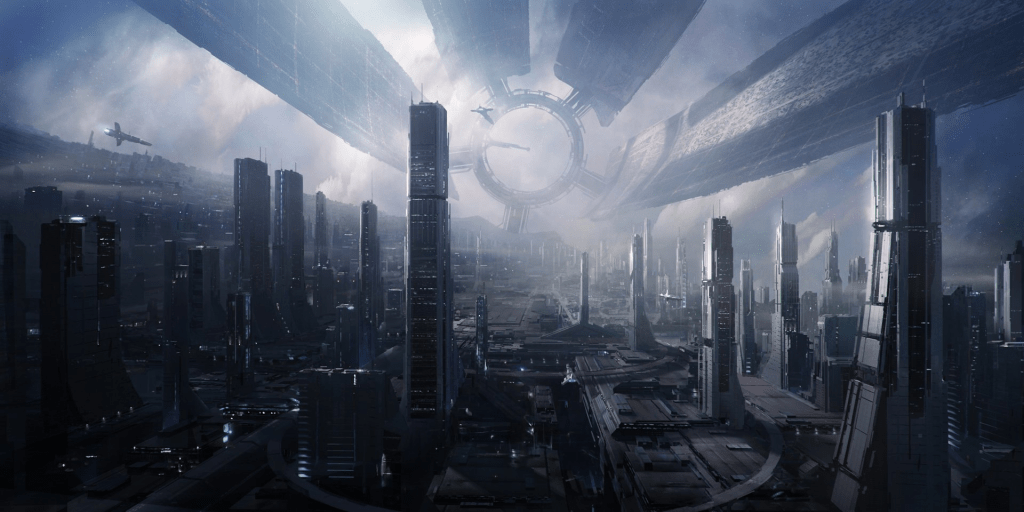
Similar to the Stanford torus is the Bernal sphere. It’s the same concept as a torus, a spinning station to simulate gravity, only the habitable part would be a gigantic sphere. Personally I think the Bernal sphere makes for much more headroom, and probably simulates a sky a lot better than a torus ever could. Imagine looking up (or in this case, across) the sphere to the other side. Instead of looking up and seeing blue sky, it would be the ground, across a big expanse of open air. I haven’t seen many Bernal spheres in fiction, though maybe the Citadel from Mass Effect gets pretty close.
The Citadel:
Of course there is the ever popular Dyson sphere, but as far as stories that feature a Dyson sphere, I can’t think of very many. There’s that one Star Trek: The Next Generation episode, but that one is a dead Dyson sphere with nobody inside. In doing research for this post, I learned about a book called ‘Star Maker’ by Olaf Stapledon that I am 100% adding to my reading list. Apparently Stapledon was the first to come up with this concept back in 1937, and later the concept was formalized by Dyson. Here’s a synopsis of the book from Google, which sounds totally bonkers by the way.
Star Maker (1937) follows an Englishman whose disembodied mind travels across space and time, observing aliens as metaphysical actors in a fiery cosmic drama remote from all human concern, and encounters the creator of the universe (Star Maker).
Wild.
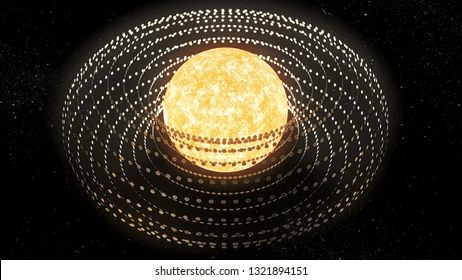
What I have yet to see in fiction is a Dyson swarm, which is similar in concept to the Dyson sphere, but a whole lot more viable if you ask me. While the Dyson sphere is a static structure, the Dyson swarm is a ton of smaller ships that can harvest energy by sitting close together and catching most of the light from a star. This has the upside of being able to run away when the unstable nature of stars inevitably causes a huge problem.
Dyson Swarm:
Speaking of energy, my personal favorite sci-fi idea for generating energy is the Penrose process, or Penrose mechanism. It involves sending an object around a spinning black hole through the ergosphere, the region of space around the black hole that is dragged along so fast that space itself is moving faster than the speed of light. From an outside perspective, the object in question could enter the ergosphere, generate some thrust, and come out the other side going much faster than it should be. Like walking on one of those human conveyer belts at the airport. The end result is that some energy was harvested from the rotation of the black hole. How you would collect that extra energy is probably the most complicated part, and the part that would involve megastructural engineering. If I had to come up with something, maybe we could accelerate a large magnet with the Penrose mechanism and then pass the magnet through an incredibly large coil to generate current. The resistance from the coil would slow the magnet back to the velocity it initially entered the ergosphere, and the process could begin again. Not sure how useful this would actually be, seeing as stars constantly pump energy out all over the place, but still. Cool concept.
Penrose process:

I’ve long since run out of time to edit this, but there are lots of other megastructures people have come up with. I’d be happy to hear about your favorites in the comments.
Thank you for reading,
Benjamin Hawley
 Dangerous Day Job