Yesterday I completely made up two different categories for jokes: clever and straightforward. Really there are thousands of ways you could categorize all different kinds of humor, but I chose those two because I want to bridge the gap between a straightforward joke that is simply, or even undefinably funny, and more clever jokes that rely on easily defined comedic elements. I think these two categories are most useful for the current exercise because they both have what the other lacks. With a full spectrum to explore, I’m hoping to dig up some answers about the objective side of humor. There’s no accounting for taste, but making a good joke doesn’t have to be all about who receives it. I hinted yesterday that somehow, comedy and other humorous writing must be related to conflict in some way. If I can pinpoint exactly what kind of conflict, I think I can make an objective basis for what makes a joke funny. If that can be done, then it makes for a solid foundation for writing original jokes or humorous scenes as well. Let’s dive in!
It would seem that straightforward jokes lean the most into the subjective side of humor. Clever jokes are ultimately easier to define, mechanically speaking, than straightforward jokes, and therefore have more objectively funny elements. For example, here’s a joke I found on Reddit’s r/jokes. Now whether you think that’s actually a decent place to find humor is debatable, but I hadn’t heard this one before and I thought it was funny. It didn’t make me laugh out loud, but I thought it was amusing. More to the point, it comes off as more clever than straightforward, and it’s clear why this would be funny whether it strikes you as such or not.
My girlfriend borrowed $100 from me. After 3 years, when we separated, she returned exactly $100.
I lost Interest in that relationship.
Credit to u/golubeerji
I’m gonna make a cardinal sin and explain the joke. It’s funny because of the word play between interest in the sense of a financial meaning, and interest in the sense of attraction between two people. The person telling the joke has created a double entendre with the sentence ‘I lost Interest in the relationship’ because it means he lost interest on the loan, and it also explains why they broke up. Double entendre is something tangible and reproduceable that can be funny. Many jokes feature double entendre (usually classified as puns), and therefore the joke has an objectively funny quality. There, I solved the mystery. Objective humor has been rationalized. Everybody knows double entendre is used in comedy.
Maybe if you’re like me you always get to this point in the explanation and now you’re wondering, ‘well, what makes a double entendre funny exactly?’ Usually people will just say that it simply is, or that it became funny because of the setup, but they can’t really explain how or why the setup made it funny. This is why explaining the joke always ruins it. Because it can’t be explained.
“Because it’s a double entendre, stupid!”
“Ok, but why-“
“Shut up about it already, you’re ruining the joke.”
It’s happened far too often.
Now, when I try to explain why this next image is funny, I immediately hit the same wall I ran into when defining why the word play was funny.
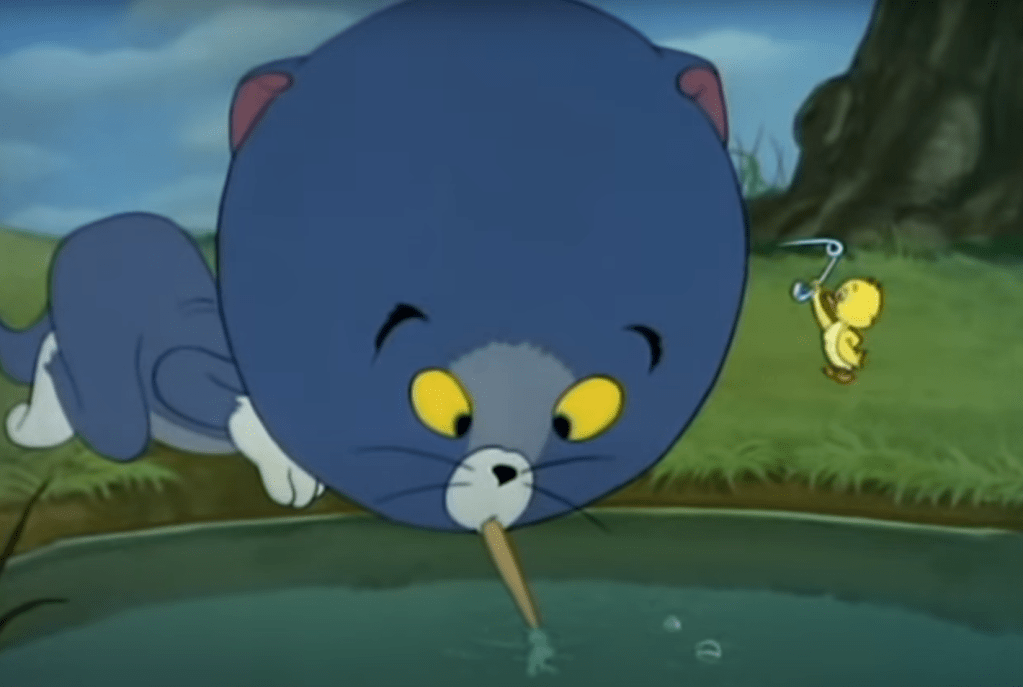
The difference is, I don’t even have a place to start. There’s really no funny quality I can define easily, so all I can say is this made me laugh. It’s not even really slapstick yet, but maybe the implication is why it’s funny. It is certainly not a double entendre though, that’s for sure. The mechanism for what happens between your eyes picking this up and your brain deciding it’s funny is murky. Maybe if I had to put it in words I would say this image is funny because I know that in the next second Tom is going to look something like this:
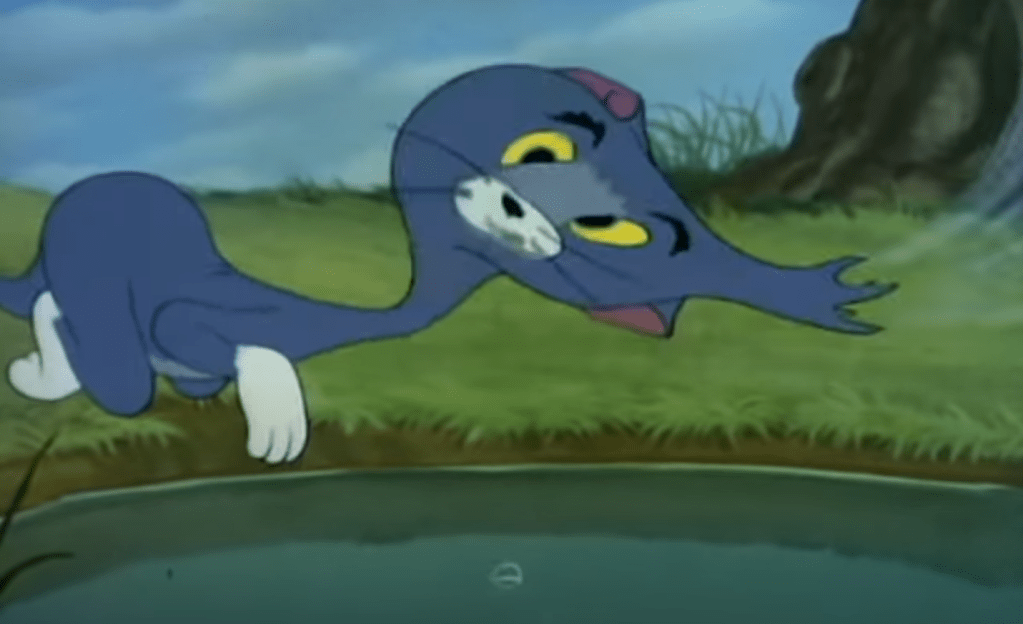
There is palpable tension in the first image, and you probably already know how the joke ends, so it gives you the whole package in one image, in a way. The full joke has a release of that tension as you can see in the second image. Much like a balloon, the gag swells up and then bursts, quite literally in this case. Tension* (see footnote) stems from conflict, and now we’ve circled back the key story telling element. But where does this conflict come from exactly?
Well, the first conflict I notice is between Tom and the duck, Little Quacker, who holds the needle. The tension stems from whether or not he will make a move to resolve the conflict between them by popping Tom’s head. That can’t be all though. If Tom was shaped normally here and Quacker was simply holding a needle to his head, it wouldn’t be as funny, would it? He could still poke Tom’s head and elicit a reaction, and maybe the reaction on it’s own would still be funny, but somehow, having a balloon shaped head makes this joke what it is. There’s another kind of conflict at play here. An obvious conflict, a trivial kind of conflict even, but that is what makes it a straightforward joke.
There is also conflict between the air pressure in Tom’s head and the atmosphere.
Trivial right? The air wants out, his head keeps it in. You know that intuitively just by glancing at this because you know how a balloon works, but you probably wouldn’t come up with that immediately if asked where the conflict in the image is.
Two forms of seemingly incongruous conflict, those being the conflict between a duck and cat, and the conflict between the pressure in a balloon and the atmosphere, work together in harmony to create a setup. The punchline lands when Little Quacker pokes Tom with the needle, and both forms of conflict are brought to same resolution at the same moment with explosive results. And hey, that kinda sounds like the reasoning behind … A double entendre! Two incongruous things brought together by a shared point. Only instead of the point of the joke being a word or phrase, it’s the point of a needle. Looks like I was wrong about the two jokes being perfectly unrelated. Funny how that happens.
Now let’s look at the clever joke again and see how it compares to the straightforward joke with the new knowledge that they are more similar than they appear. Is it easier to explain why the double entendre is funny now?
My girlfriend borrowed $100 from me. After 3 years, when we separated, she returned exactly $100.
In the setup, a loan is borrowed and the relationship comes to an end. There are two points of conflict here that generate tension. One is the loan, which is essentially an unresolved transaction. There is conflict here because the person who loaned the money wants the money back, and the girlfriend, who we are soon told has since separated from the person telling the joke, probably doesn’t want to pay back a handshake loan to an ex. An unpaid loan creates tension as it hangs in the balance, with the obvious resolving mechanism being to pay back the loan. Even as the loan is payed back and that tension resolves at the end of the setup, it leaves you wondering what the point of the loan being in the joke was, which is a form of tension all it’s own.
For the other conflict, it is of course, the relationship. After being told it has ended the natural instinct is to wonder how. Tension would be resolved upon being informed of how the relationship ended. This hanging question is enhanced by the tension caused when the loan is resolved seemingly prematurely at the end of the setup. If the only other element in the joke, the loan, was explained, then surely the relationship must be explained by the end of the joke as well.
I lost Interest in that relationship.
The interest paid on a loan, and the interest one has in a lover have nothing to do with each other whatsoever, right up until the moment circumstances force them to come crashing together. The result, a powerful release in the punchline, just like the air escaping poor Tom’s head. ‘Oh, that’s what happened to the relationship,’ and ‘oh, that’s why the loan was resolved already,’ occur at the same time.
These two jokes could not be less alike. One is purely visual, and the other is purely wordplay. One is modern, and the other was created decades ago. One is to amuse children, and the other is to amuse Redditors. Actually, that one might be a similarity now that I think about it. But my point is that these two jokes, despite being nothing alike, ultimately have the same structure. A setup where two points of conflict are defined (including the potential resolutions that allow tension to form, even if implied), and a punchline where those forms of conflict are resolved in one fell swoop. I would go so far as to say that all comedy is related to these principles. Conflict, tension, and resolution.
If that sounds like everything other form of fiction ever, then it’s because it kind of is. The difference between a joke, and say, a suspenseful scene, is that the precise outcome of a joke should be surprising, but the setup is essentially the same. Comedy is a blend of suspense and surprise. In fact, a suspenseful scene can easily come off as comedic if something unexpected happens to resolve the tension. It won’t necessarily be good comedy, seeing as the setup wasn’t very intentional, but it can still elicit the same response.
For example … https://youtu.be/3wHYVOm4f7Q
Even in the Tom and Jerry scene, it isn’t entirely clear at first how tom will end up, probably because you’ve never seen a cat’s head explode like a balloon before. The scene is also very quick, giving you no time to expect the unexpected. Here is how it ended, and there’s a link to the video I used for these past two posts in the footnotes.

Thank you for reading,
Benjamin Hawley
* Here I’m making the distinction between conflict and tension. I define tension as the feeling that is created when the mechanism that could resolve conflict is revealed. In this case you see the duck with the needle and you know he has the potential to pop Tom’s head.
Tom and Jerry video: https://youtu.be/ybr5tj5Umww Thanks for collecting the scenes mishka mchedlidze.
 Dangerous Day Job