Have you ever heard someone with a penchant for womanizing referred to as a ‘Casanova’ or a real ‘Don Juan?’ What about an overly pessimistic person being called a ‘Debby Downer,’ a talkative sort as a ‘Chatty Cathy,’ or know-it-all as a ‘Smart Aleck?’ There are tons of these little character archetypes we refer to in everyday conversation, often without even thinking about it. I love these the little prepackaged characters because they can refer to a very specific kind of person who might not have an easy title otherwise. You know exactly who an Average Joe, Mary Sue, Uncle Tom, or Bond-type is, but they don’t need awkward names like ‘extremely average character,’ or ‘unrealistically perfect character’ to get those traits across. Where do these characters came from? Moreover, how do they manage to worm their way into daily parlance for hundreds of years in some cases? These are the questions that keep me up at night.
Don Juan originated in the 1630 play ‘El burlador de Sevilla y conbidado de piedra’ (The Trickster of Seville and the Stone Guest) by Tirso de Molina. The character Don Juan (or later Don Giovanni) was a Spanish man of loose morals who devoted himself to seducing women and was ultimately dragged to hell by a man he murdered for his freewheeling lifestyle, thus becoming a legend in the process. The play was adapted many times over the centuries, including a 1787 opera with music by Mozart. The latest I could find was a widely panned musical from 2022. And they say Hollywood recycles too much. This dude has been in fiction for almost 400 years now and sometimes they still don’t get it right.
Anyway I find it interesting that a classic tale could become so well-known across multiple languages that the main character is an archetype beyond the bounds of his story. It’s clear how this came about, what with the popularity of the play, but what about the other characters? Surely there’s no play for all of them right? I think you might find their origins interesting.
Chatty Cathy was originally a doll manufactured in the 1960s with a pull-string that made her talk. That adds up, I suppose, even if we’ve all collectively forgotten where the name came from.
Uncle Tom is of course from Harriet Beecher Stowe’s classic ‘Uncle Tom’s Cabin,’ which by the way I just learned was the second best-selling book of the 19th century right behind the Bible (Damn!). If you actually read the story though it isn’t as clear why Uncle Tom got his reputation compared to a character like Don Juan. He’s widely used now as an insult for a black man considered a race traitor, but in the story Uncle Tom ultimately refuses to betray his friends and family to the white slavers he suffers under, proving where his true loyalties lie. It’s a little strange that a Don Juan or a Chatty Cathy is exactly what they were in their original presentation, but an Uncle Tom is the opposite of what the author intended the character to be. Clearly there are some social reinterpretations going on somewhere along the line when it comes to some of these archetypes.
Average Joe, true to his name, seems to have popped up from the general masses without much fanfare sometime in the early 1900s. Nobody knows where this term really came from. That’s poetry in motion right there.
Mary Sue first appeared in a parody of Star Trek fanfiction called ‘A Trekkie’s Tale,’ by Paula Smith in 1973. She was a stand in for all the hyper-idealized female characters that showed up in fanfiction, and has been used ever since to critique every new writer’s perfect self-insert.
Another of my favorites I didn’t mention before is actually much older, so old now that we don’t even use his name as a proper noun anymore. A narcissist is a self-obsessed person who holds themselves above the rest of humanity. Originally the term was invented by German psychiatrists Paul Nacke and Havelock Ellis in 1889 to describe someone who is sexually attracted to their own body. The term was based on the story of Narcissus from Greek mythology, who was so handsome that he fell in love with his own image reflected in a pool of water. He lingered there, pining for himself who he could never hold, until dying of thirst and starvation. I wonder if people referred to the self-obsessed as a Narcissus before the psychological term, or if the use of archetypal language like Don Juan or Uncle Tom influenced the psychologists enough for them to go back and use an archetype from an earlier period in a similar way?
Freud based the terms Oedipus complex and Electra complex on Greek myths similarly. I’d guess he was following the trend set by narcissism, mania, phobia, etc, but I don’t have a source for that.
Lately there’s a new breed of character archetype on the rise based on internet culture and memes. We’ve probably all heard the term ‘Karen’ by now,

referring to the type of person who is more than happy to complain to your manager, but there are countless others popping up faster and faster. One particularly rapid breeder is known as ‘Chad.’ Chads predate Karens, and are kinda like a modern-day Don Juan, although I’ve also seen the term used to refer to morally upstanding men as well in a reinterpretation of what it ultimately means to be hyper-masculine. Here is the Virgin vs Chad meme format that the Chad archetype comes from.

Usually Chad is doing something hyper-masculine compared to his Virgin counterpart there on the left. I’ve seen it used for various purposes:
A. Direct mockery of the actions of the Virgin.
B. Satirical mockery of the actions of the Chad.
C. Ironic mockery of the entire situation that results in a Virgin vs Chad setup.
D. All or none of the above.
Here’s an example that probably won’t piss anybody off.

Chad has transcended this original meme template though, with his later iteration as a Wojack meme (another complex meme archetype I don’t have the time to explain here). This is called the ‘Yes Chad’ based on his use in the Wojack memes.
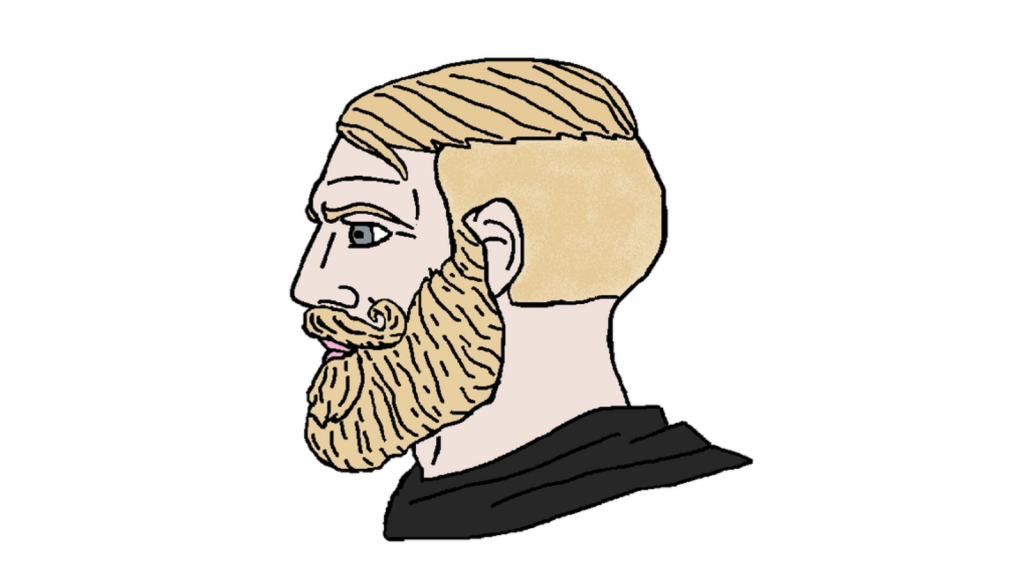
Here’s the original use of Yes Chad from a 2019 Twitter post by @yachs_91.
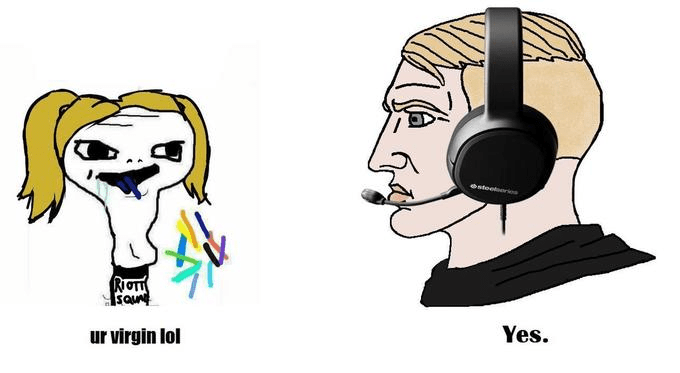
Ironically, the Chad has somehow become the Virgin in this meme while still retaining his Chad status. That reinterpretation into the opposite of what he was meant to be originally is weirdly reminiscent of Uncle Tom’s reinterpretation into a race-traitor, now that I think about it.
That’s not sentence I ever thought I’d write.
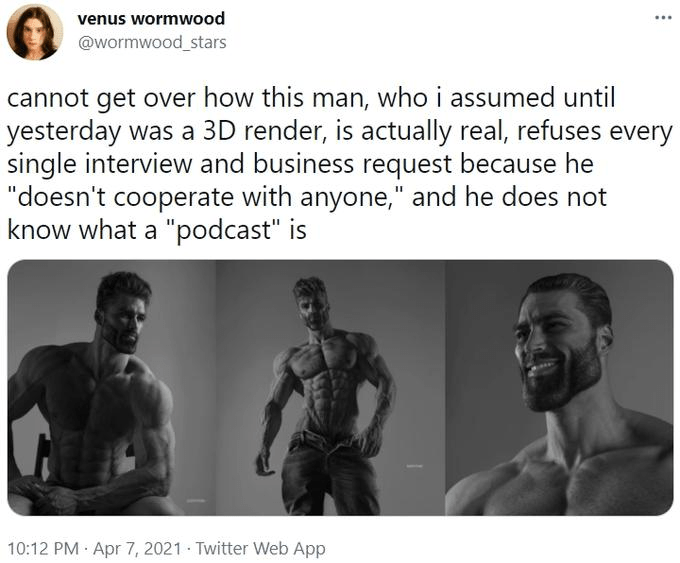
Here’s my favorite version of the Chad meme, the Gigachad, who actually predates the Yes Chad by a couple years. This is model Ernest Khalimov, who is now the de facto face of hyper masculinity, for obvious reasons.

This one has too many iterations to even count, but you can read more about him here: https://knowyourmeme.com/memes/gigachad
This post pretty much sums him up.
This is all just to show how a simple character archetype can rapidly explode into countless variations that get harder and harder to keep track of as time goes on. Apparently even the use of Chad predates any sort of meme culture, originating in Chicago in the 1990s when it became derogatory slang for successful young white men who are condescending to others. Various urban dictionary definitions from the early 2000s reference Chad, later dubbed Chad Thundercock, which is also not a sentence I ever thought I’d type.
I’m not sure if the internet accelerates the evolution of these character archetypes, or just makes it easier to see how quickly they change. I mean, did Don Juan also undergo countless reinterpretations in the span of a few years after the original play? I could see this happening, all localized to distinct groups of people who had little or no contact with one another, all talking about that new and controversial Don Juan character and inventing their own uses. In this case, all the internet would be doing is recording a bunch of individual conversations for later reference, something that wasn’t possible before. The record of how quickly this character spreads and evolves would show it being much higher than someone like Don Juan or Mary Sue, but what if that’s just because it’s all recorded? If a Don Juan becomes a GigaDon, but nobody else is around to see it, does the GigaDon really exist?
I think may need to lay off the caffeine.
Thank you for reading,
Benjamin Hawley
 Dangerous Day Job