I’ve always found it interesting how books, movies, TV shows and other media are rated based on numeric scales. Personally I don’t think it makes much sense to try to quantify what is undoubtedly subjective material. A 2/10 could be a 2/10 because it had bad writing, or it could be a 2/10 because it directly insulted that specific reviewer’s mother. There’s so much difference between media of a similar rating that I just don’t see the point really. I think there are just too many different reasons you might like or dislike a particular story for any two identical ratings to actually convey the reason you would want to watch or read it. There are however a couple of rating systems that I’m a huge fan of and today I want to talk about how they work differently.
First off is probably the most popular rating site today, Rotten Tomatoes. The thing I like about it is that the Tomato Meter you see is actually just a representation of how many people gave the media a positive rating. The number itself is not taken into account as long as it’s above a certain threshold, as far as I’m aware. This eliminates some of the issues with a subjective rating because it’s an aggregate score based on everyone who reviewed it. Better yet, the rating is just positive or negative, no splitting hairs here.
It could be improved though. Why let users make a star rating at all if you’re just going to aggregate the numbers and make them meaningless? One might argue that they are meaningless to begin with if there’s no standard anyway. And furthermore, why should I trust a bunch of random faceless people, or even the official critics for that matter? What if the people rating these movies and TV shows are really stupid and the best way to find a good movie is to look for the ones that people don’t like? You could go to the details page and read the individual reviews, but again, these are held back by an arbitrary star system. Worse, the critics’ reviews are actually based on a different system where each individual critic has their own scale. The critic reviews actually just take you straight to their website for a full review. On Rotten Tomatoes, this just shows up as a positive or negative score. Again, the break down ends up being a positive or negative impression, with further reading required if you want to decide to trust the reviewer.
The only rating system I particularly enjoy is the Steam rating system. It solves most of the issues I mentioned before. It only applies to video games sold on Steam of course, but in my opinion it’s best system to rate media out there. The simplicity is where it shines. Users give their games either a negative or positive, and follow it up with some commentary about their choice. That’s it. Compare this to something like Goodreads, which has a star system. The official star system goes like this:
1 star – didn’t like it
2 stars – it was OK
3 stars – liked it
4 stars – really liked it
5 stars – it was amazing
There’s a problem though, because users don’t stick to these with any consistency. In fact, here’s a whole thread on Goodreads where people talk about their own, personal definitions for what the stars mean. This makes the aggregate basically meaningless. Even though Goodreads has attempted to create a standard, the overcomplicated star system has left way too much wiggle room for users to invent their own standards. This attempt at quantifying the subjective has, in my opinion, failed.
Compare this to Steam once again, and we see that the ratings are absolute. You either liked it or you didn’t. There could be a million reasons why, so it lets you write a review. Of course Goodreads also lets you write a review, but the difference is, if two people wrote very similar reasons for enjoying a book, they could still rate the book with a different number of stars. Even if their logic is identical, you might not get a consistent review. Not the case with a Steam review.
There’s another point that makes this system shine particularly well. See if you can spot it from this screen shot of the Steam reviews page for Elden Ring.
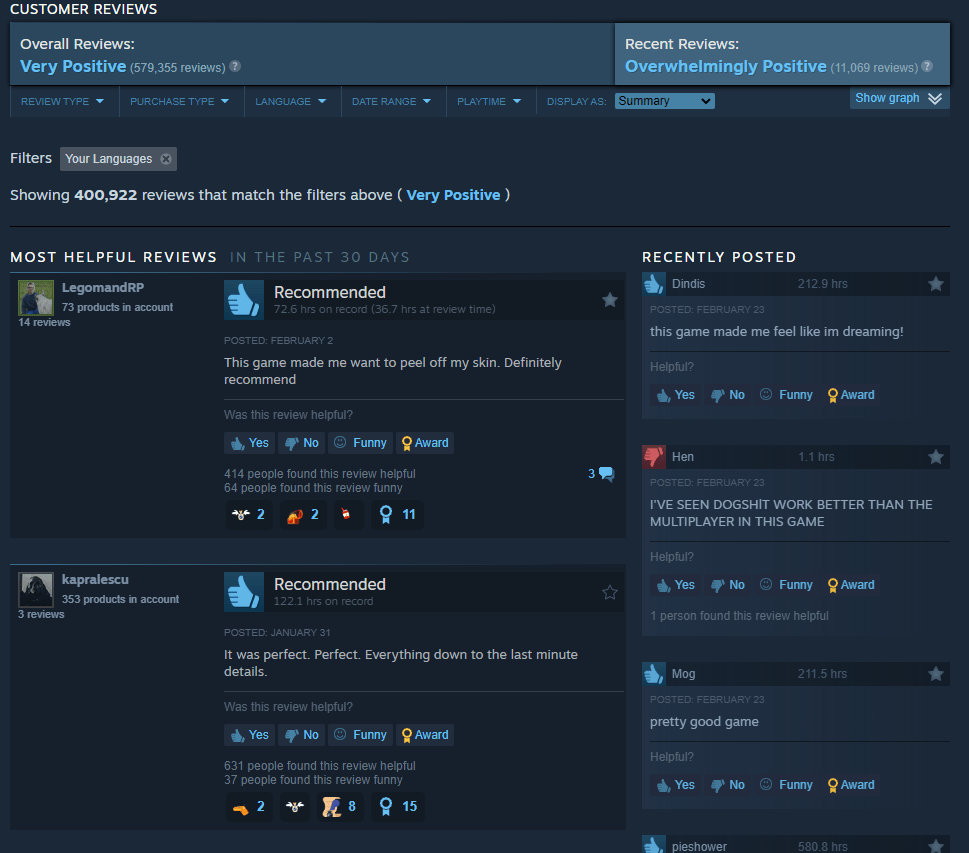
Take note of the little piece of information it gives you below the review, ‘hrs on record.’ This is the number of hours someone has put into the game. While simplistic, this does give the prospective buyer a metric for how much stock you should put into a review. Most games take a long time to complete, so if you see a review like the one on the right there, where the player only put 1.1 hour into the game, you know they didn’t actually finish it. It makes me wonder how many movie and book reviews come from people who didn’t finish the piece of media they’re telling me about as if they’re an authority on it. I myself have written reviews for media I didn’t finish, but that was part of the review, and it was the first thing I wrote down. If I didn’t finish it, I had a very good reason. I’ve also given generally negative reviews of books I have finished, and it would only be natural for you to put more stock in those reviews than the DNFs.
It also gives you some interesting information for the featured reviews, letting you know how many other products the user has in their account. Someone who has never played a video game in their life except for this one is going to have a different perspective compared to someone who has played hundreds of games.
Finally, there’s the aggregate information at the top. It tells you very simply if the percentage of reviews are overwhelmingly negative, negative, mixed, positive, or overwhelmingly positive based on everyone who has reviewed the game. It also has a recent reviews section since video games tend to change over time as they receive updates. I appreciate the approach to this much more than I appreciate something similar like Rotten Tomatoes because it is consistent throughout. There’s nothing lost in translation from individual to aggregate like an arbitrary star system. Like I said, the straightforward nature of the system is where it shines the most. Honestly I wish this system were more universal. I’m tired of trying to figure out what a bunch of stars or X/10 means.
What review sites do you use? Are there any systems you would like to see more often? Let me know in the comments.
Thank you for reading,
Benjamin Hawley
 Dangerous Day Job